What Is an Affordability Assessment? UK Guide
An affordability assessment helps a lender consider whether repayments may be affordable for a customer. It looks at the risk that new credit could put too much pressure on their finances.
However, affordability is not only about making the first payment. A lender may need to consider whether repayments can be made over the life of the agreement.
For regulated consumer credit, affordability risk forms part of a wider creditworthiness assessment. The exact checks can vary between lenders and agreements.
This guide explains what an affordability assessment is and how it may work. It also covers income, spending, credit checks and catalogue credit.
Important: BuyNowPayLaterCatalogue.co.uk is an independent information and referral website. We are not a lender and do not provide credit. Credit products, eligibility rules, costs and terms vary between providers. Always check the provider’s current terms before entering into a credit agreement.
What Is an Affordability Assessment?
An affordability assessment considers the risk that credit repayments could cause financial problems.
In simple terms, a lender considers whether you may be able to make the repayments without putting too much pressure on your finances.
For regulated consumer credit, affordability forms part of the lender’s wider creditworthiness assessment.
The FCA requires lenders to carry out a reasonable creditworthiness assessment before entering into regulated credit agreements covered by its rules.
That assessment considers two broad areas.
First, the lender considers credit risk. This includes the risk that payments will not be made when due.
Second, it considers affordability risk. This looks at the possible effect of the repayments on the customer.
Therefore, an affordability assessment is not simply about whether the lender expects to get its money back.
Why Is an Affordability Assessment Important?
Borrowing creates a new financial commitment.
Therefore, it is important to consider how that commitment may affect your budget.
For example, someone may have repaid previous credit on time. However, that person could already have high household costs.
Another customer may have several existing debts.
As a result, another repayment could put extra pressure on their finances.
An affordability assessment helps a lender consider that risk.
However, no assessment can predict every future event.
Your income could change. In addition, household bills could increase.
Therefore, you should also check your own budget before borrowing.
How Does an Affordability Assessment Work?
There is no single test used by every lender.
Instead, an affordability assessment can vary according to the agreement and circumstances.
For regulated credit, the FCA expects the assessment to be reasonable and proportionate.
Therefore, the checks used for one application may differ from those used for another.
A lender may use information you provide.
It may also consider information it already holds about you.
In addition, information from a credit reference agency may be relevant.
The lender can consider the amount of credit too. The size and frequency of repayments can also matter.
As a result, you should not expect every lender to use an identical process.
What Can an Affordability Assessment Check?
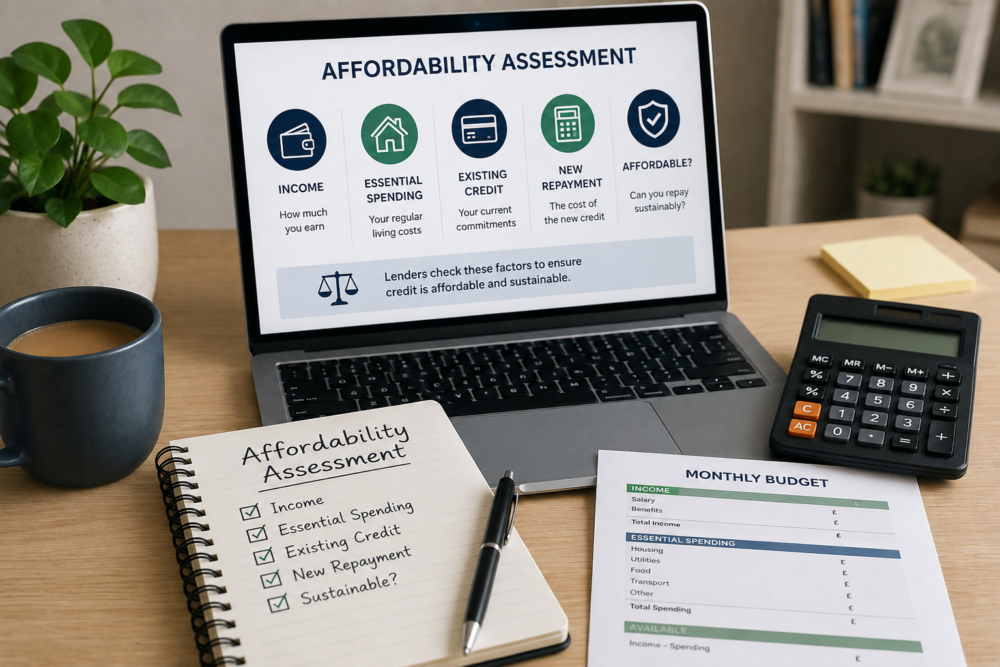
An affordability assessment can consider several parts of your finances.
The exact information will depend on the lender and agreement.
For example, relevant information may include:
- your income;
- essential household spending;
- existing credit commitments;
- other debts;
- the amount of credit;
- the size of each repayment;
- how often payments are due;
- the length of the agreement; and
- other information relevant to affordability.
However, not every lender will ask for all of this information in the same way.
The checks may also depend on the level of risk.
Affordability Assessment and Your Income
Income can be an important part of an affordability assessment.
After all, repayments need to fit within the money you have available.
A lender may ask about your income during an application.
Depending on the circumstances, it may also take steps to check the information.
For regulated credit, FCA rules can require a lender to determine or make a reasonable estimate of income.
However, the exact method can vary.
Income may also come from different sources.
Therefore, an application may ask for more information than your salary alone.
Can an Affordability Assessment Check Your Bank Account?
Not every affordability assessment requires direct access to a bank account.
Lenders can use different sources of information.
For example, they may ask you to provide information directly.
Other information may also be available to them.
Therefore, check the lender’s application and privacy information.
This should explain what data may be collected or used.
Affordability Assessment and Household Spending
Income is only one side of an affordability assessment.
Your spending matters too.
For regulated credit, FCA rules refer to non-discretionary spending when assessing affordability risk.
In simple terms, these are costs that are difficult or impossible to avoid.
For example, they can include essential living costs.
Existing financial commitments can also be relevant.
Therefore, two people with the same income may have very different budgets.
One may have high housing costs. Another may have several existing debts.
As a result, income alone does not show whether a new repayment may be manageable.
What Spending Can an Affordability Assessment Consider?
An affordability assessment may take account of essential costs and existing commitments.
For example, these could include:
- rent or mortgage payments;
- council tax;
- gas and electricity;
- food and household essentials;
- travel costs;
- childcare;
- insurance;
- existing credit repayments; and
- other essential commitments.
However, every household is different.
For example, a family with children may have different costs from someone living alone.
Therefore, an assessment should not be reduced to income alone.
Affordability Assessment and Existing Debt
Existing borrowing can be relevant to an affordability assessment.
You may already have a credit card or loan.
You could also have an overdraft or another catalogue account.
Each repayment uses part of your available income.
As a result, several small debts can create a larger financial commitment.
A lender may consider existing commitments when assessing affordability.
However, you should consider them yourself too.
First, write down your existing repayments.
Then add the proposed new payment.
This can give you a clearer view of your total credit commitments.
Affordability Assessment vs Credit Check
An affordability assessment and a credit check are related. However, they are not the same thing.
A credit check can provide information about your credit history.
For example, it may show credit accounts recorded on your credit file.
An affordability assessment has a different focus.
It considers the risk that making the repayments could cause financial problems.
A lender may use credit reference information as part of its wider checks.
However, this does not make the two terms interchangeable.
Our guide to what a soft credit check is explains credit searches in more detail.
Can an Affordability Assessment Affect Your Credit Score?
An affordability assessment does not automatically tell you whether your credit score will be affected.
Instead, the effect can depend on the checks used.
For example, a lender may use a soft credit search.
In other cases, a hard search may be used.
These searches work differently.
Therefore, check what type of search may take place before applying.
Do not assume every lender uses the same credit-check process.
Affordability Assessment for Catalogue Credit
An affordability assessment can be relevant when applying for catalogue credit.
However, catalogue providers can offer different types of agreement.
Some agreements may be regulated. Others may fall within an exemption.
As a result, the rules that apply can differ.
Where FCA consumer credit rules apply, affordability risk forms part of the required creditworthiness assessment.
Providers may also use their own eligibility criteria.
Therefore, read the application information before you apply.
Our guide to how catalogue credit works explains the wider process.
Affordability Assessment for Regulated Credit
An affordability assessment is particularly important when the relevant FCA consumer credit rules apply.
A regulated lender must carry out a reasonable creditworthiness assessment before entering into an agreement covered by those rules.
Affordability risk forms part of that assessment.
The lender considers the risk that repayments could cause financial difficulty.
For example, it considers whether repayments can be made as they fall due.
It also considers the risk that further borrowing may be needed to make those payments.
In addition, repayments should not prevent required payments from being made elsewhere.
The lender also considers the risk of a significant negative effect on the customer’s finances.
Therefore, an affordability assessment is about more than having enough money for one payment.
Affordability Assessment for Unregulated Credit
The FCA’s regulated credit rules do not apply in the same way to every agreement.
Some credit agreements may qualify for an exemption.
Therefore, the regulatory requirements around an affordability assessment can differ.
However, affordability remains important for the customer.
You still have to make the agreed payments.
So, you should check your own budget before entering any credit agreement.
Also read the provider’s current terms.
Our guide to regulated vs unregulated credit explains how regulatory status can differ.
Does an Affordability Assessment Guarantee Approval?
No. An affordability assessment does not guarantee approval.
Affordability is only one part of a lending decision.
For example, a lender may consider credit risk too.
It may also have its own eligibility criteria.
As a result, an application can still be declined.
Alternatively, a provider may offer different terms.
Therefore, never treat an affordability check as a promise of credit.
Can an Affordability Assessment Affect Your Credit Limit?
An affordability assessment may be one factor in deciding how much credit to offer.
However, lenders can consider several factors.
For example, credit risk may also matter.
A lender’s own policies can affect the decision too.
Therefore, affordability alone may not determine a credit limit.
As a result, different customers may receive different outcomes.
Can an Affordability Assessment Be Wrong?
An affordability assessment cannot predict every future event.
Your financial position can change after you apply.
For example, your income could fall.
Your rent or energy costs could increase.
In addition, an unexpected expense could affect your budget.
Therefore, lender checks should not replace your own judgement.
Try to leave some room in your budget for unexpected costs.
A repayment may become harder to manage if there is no spare money.
How to Do Your Own Affordability Assessment
You can carry out a simple affordability assessment before applying for credit.
First, work out your regular income.
Next, list your essential household costs.
Then add your existing credit payments.
After that, think about less regular costs.
For example, you may need money for car repairs or school costs.
Finally, add the proposed new credit payment.
Look at how much money remains.
Would you still have enough for essential spending?
Also consider unexpected bills.
If the budget only works when nothing goes wrong, it may be too tight.
Affordability Assessment Questions to Ask Yourself
A personal affordability assessment can start with some simple questions:
- How much income do I receive?
- How reliable is that income?
- What are my essential household costs?
- How much do I already repay on credit?
- How much will the new payment be?
- How often will I need to pay?
- How long will the agreement last?
- Could I cope if a household bill increased?
- Would I need to borrow again to make the payment?
- Would I still have enough for essentials?
These questions cannot predict the future.
However, they may help you see whether your budget has enough room for another commitment.
Affordability Assessment for Weekly Payments
An affordability assessment should consider how often repayments are due.
Weekly payments may look smaller than monthly payments.
However, they are due more often.
Therefore, do not focus only on the size of one payment.
Check how many payments you need to make.
Also look at the total amount payable.
If you budget monthly, remember that there are 52 weeks in a year.
Therefore, multiplying a weekly payment by four can give an inaccurate monthly comparison.
Our pay weekly vs pay monthly guide explains this in more detail.
Affordability Assessment and Catalogue Pre-Payments
An affordability assessment should also take account of any payments required before dispatch.
Some catalogue agreements may involve pre-payments.
If they apply, include them when checking your budget.
Also check when the goods should be dispatched.
A number of pre-payments may be required in some cases.
However, requirements can vary between providers and customers.
Therefore, do not assume another customer’s experience will apply to you.
Check the current terms instead.
Our catalogue pre-payments guide explains how pre-payments can work.
Affordability Assessment and 0% Interest Credit
An affordability assessment can still be relevant when credit charges 0% interest.
After all, you still need to repay the amount borrowed.
Therefore, 0% interest does not automatically mean credit is affordable.
For example, a large interest-free repayment could still put pressure on your household budget.
Check the size of each payment.
Also check how often you need to pay.
Finally, look at the agreement length and total amount payable.
Affordability should come before the attraction of an interest-free offer.
What If an Affordability Assessment Leads to a Decline?
An affordability assessment can form part of a decision to decline an application.
However, there may be other reasons too.
A declined application can be disappointing.
Even so, avoid making several new applications without first reviewing your position.
Instead, look at your household budget.
You may also want to check your credit reports for errors.
However, a decline does not automatically mean something is wrong with your credit file.
Lenders can use different lending criteria.
Therefore, another lender may reach a different decision.
That does not automatically mean further borrowing is affordable.
Affordability Assessment Warning Signs
Your own affordability assessment may highlight signs of financial pressure.
For example, you may already struggle with essential bills.
You may be using credit to pay for food or household costs.
You might also be borrowing to repay other borrowing.
These can be warning signs.
Therefore, adding another repayment may make your finances harder to manage.
In that situation, free debt support may be more useful than another credit application.
Affordability Assessment FAQs
Is an Affordability Assessment a Credit Check?
No. An affordability assessment and a credit check are different. However, credit reference information may form part of a lender’s wider checks.
Does an Affordability Assessment Hurt Your Credit Score?
Not simply because it is an affordability assessment. The effect depends on the checks used. For example, a lender may use a soft or hard credit search.
What Information Is Used in an Affordability Assessment?
The information used in an affordability assessment can vary. Income, essential spending and existing credit commitments may be relevant.
Do All Lenders Use the Same Affordability Assessment?
No. There is no single affordability assessment used by every lender. For regulated consumer credit, the assessment should be reasonable and proportionate to the circumstances.
Does an Affordability Assessment Guarantee Credit?
No. An affordability assessment does not guarantee acceptance. A lender can consider other information and apply its own lending criteria.
Can an Affordability Assessment Consider Existing Debts?
Yes, existing financial commitments can be relevant to an affordability assessment. However, the information considered can vary by lender and agreement.
Does 0% Credit Need an Affordability Assessment?
An affordability assessment can still be required where relevant regulated credit rules apply. Charging no interest does not remove affordability risk.
Affordability Assessment: Key Points
An affordability assessment helps a lender consider the risk that repayments could cause financial problems.
For regulated consumer credit, affordability risk forms part of the wider creditworthiness assessment.
However, there is no single test used by every lender.
An affordability assessment may consider income, essential spending and existing commitments.
The amount and frequency of the proposed repayments can also matter.
However, an affordability assessment does not guarantee approval.
It also cannot guarantee that your circumstances will stay the same.
Therefore, check your own budget before borrowing.
Make sure you can cover essential costs.
Also consider whether you could cope with an unexpected bill.
Most importantly, do not take more credit simply because the regular payment looks small.
If you are struggling with debt or household bills, free help is available. MoneyHelper, Citizens Advice and StepChange provide independent information and support.
For more information about catalogue credit, visit our Buy Now Pay Later Catalogue information hub.
Editorial information: This guide provides general information about affordability assessments and consumer credit in the UK. It is not personal financial advice. The checks used can vary between lenders and agreements. Credit rules and provider terms can also change. Check current information before entering into a credit agreement.
Last reviewed: August 2026.