Catalogue Pre-Payments Explained: UK Guide
Catalogue pre-payments are payments that some catalogue providers may ask you to make before goods are sent. They can form part of the provider’s credit process. However, the rules can vary by provider, product and customer.
For example, a provider may ask for a number of payments before it dispatches an order. This does not mean every customer will face the same terms. It also does not mean every catalogue credit product uses pre-payments.
So, it is important to check the terms before you agree to anything. You should know how much you will pay and when goods may be sent.
This guide explains catalogue pre-payments in plain English. It also looks at affordability, credit checks, delivery and the wider credit agreement.
Important: BuyNowPayLaterCatalogue.co.uk is an independent information and referral website. We are not a lender and do not provide credit. Credit products, eligibility rules, costs and terms vary between providers. Always check the provider’s current terms before entering into a credit agreement.
What Are Catalogue Pre-Payments?
Catalogue pre-payments are payments made before an order is dispatched.
They may be required as part of some catalogue credit arrangements.
For example, you might apply for catalogue credit and place an order. The provider may then ask you to make a number of payments before it sends the goods.
However, this process is not used by every catalogue provider.
Also, the number and value of payments may vary.
Therefore, never assume that one catalogue’s rules apply to another.
You should read the terms for the exact credit product you are considering.
How Do Catalogue Pre-Payments Work?
The exact process for catalogue pre-payments depends on the provider.
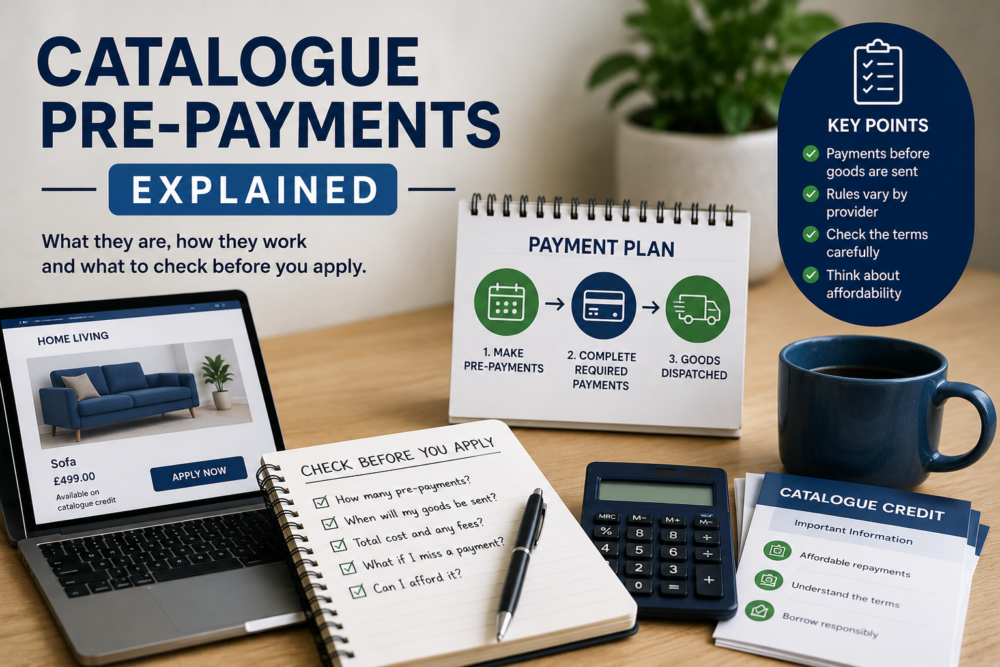
First, you may need to open an account.
The provider may then carry out checks. These could include a credit check and an affordability assessment.
Next, you may be given a payment plan.
Depending on the product and your circumstances, you may need to make payments before dispatch.
You would then make the required payments under the provider’s terms.
Once the relevant conditions have been met, the provider may dispatch the goods.
However, you should not assume that one payment will trigger dispatch. You should also not assume that every customer must make the same number of payments.
Why Might Catalogue Pre-Payments Be Required?
A provider may use catalogue pre-payments as part of the way it manages credit risk.
In simple terms, lending involves risk.
A business may need to decide whether it is willing to provide goods before the customer has paid the full price.
Its decision may depend on several factors.
For example, these could include the type of credit agreement and the provider’s lending rules.
The customer’s circumstances may also be relevant.
However, you should not assume that a request for pre-payments means you have poor credit.
There may be several reasons for the provider’s decision.
Likewise, making pre-payments does not guarantee future access to credit.
How Many Catalogue Pre-Payments Are Required?
There is no single number of catalogue pre-payments that applies to every customer or provider.
This point is important.
A number of pre-payments may be required before an order is dispatched.
However, the exact requirement can depend on the provider’s terms and the customer’s circumstances.
So, avoid assuming that you will need to make a fixed number of payments.
Instead, check your own agreement.
The provider should explain the payment terms that apply to your account.
If the terms are unclear, ask the provider before making a commitment.
Do All Catalogues Use Catalogue Pre-Payments?
No. Catalogue pre-payments are not a feature of every catalogue account.
Catalogue credit can work in several ways.
Some providers may send goods before you have made the first regular repayment.
Others may require payments before dispatch in certain cases.
In addition, a provider may offer more than one type of payment plan.
The terms can therefore differ within the same business.
This is why it is useful to check the exact product.
Our guide to how catalogue credit works explains the wider process.
Are Catalogue Pre-Payments the Same as a Deposit?
Catalogue pre-payments should not automatically be described as a deposit.
The words may sound similar. However, they can mean different things.
A deposit is usually an upfront payment linked to a purchase.
A pre-payment may instead form part of a payment schedule before dispatch.
The legal and practical position will depend on the agreement.
Therefore, check how the provider describes the payment.
Also check how it is treated under the agreement.
Do not rely only on the label used in an advert or product page.
Do Catalogue Pre-Payments Reduce What You Owe?
You should check how catalogue pre-payments are applied to your account.
In many arrangements, payments form part of the amount you are required to pay.
However, you should not assume this without checking the terms.
Look for the cash price of the goods.
Then check the amount of credit.
Also check the total amount payable, where this applies.
Finally, check how each payment is used.
This will help you understand what you are paying for.
If the terms are unclear, ask the provider to explain them.
Catalogue Pre-Payments and Delivery
Catalogue pre-payments can affect when goods are dispatched.
This is one of the most important points to understand.
If your agreement requires payments before dispatch, you may not receive the goods straight away.
Instead, you may need to complete part of the payment plan first.
Therefore, do not assume that opening an account means immediate delivery.
This matters if you need an item by a certain date.
For example, you may need a bed, appliance or other household item quickly.
In that case, check the expected dispatch process before you commit.
If the timing does not suit your needs, consider other ways to buy the item.
Do Catalogue Pre-Payments Guarantee Dispatch?
You should not treat catalogue pre-payments as a guarantee of a particular outcome.
Providers can have different conditions.
For example, an account may remain subject to checks or other terms.
Therefore, read the full agreement.
Check what must happen before goods are dispatched.
Also check what could delay an order.
If anything is unclear, contact the provider.
It is better to understand the process before relying on a delivery date.
Catalogue Pre-Payments and Affordability
Catalogue pre-payments do not remove the need to think about affordability.
A smaller regular payment can look manageable.
However, you need to consider the full payment plan.
First, look at your income.
Next, list your essential bills.
Then add your existing debt payments.
After that, consider the new catalogue payment.
You should also leave room for unexpected costs where possible.
For regulated consumer credit, lenders must consider creditworthiness. This includes the risk that repayments may not be affordable.
However, there is no single affordability test used by every lender.
You can learn more in our guide to what an affordability assessment is.
Catalogue Pre-Payments and Credit Checks
Catalogue pre-payments and credit checks are separate things.
A pre-payment is a payment.
A credit check looks at information linked to your credit history.
A provider may use credit information when deciding what credit it can offer.
However, providers do not all use the same process.
Some checks may be soft searches.
Other applications may involve a hard search.
Further checks can also take place later.
Therefore, check the provider’s application process before applying.
Our soft credit check guide explains soft and hard searches in more detail.
Catalogue Pre-Payments and Your Credit Score
Making catalogue pre-payments should not be viewed as a guaranteed way to improve your credit score.
Credit scoring is more complex than that.
Different credit reference agencies can hold different information.
Lenders can also use their own scoring systems.
In addition, not every payment arrangement is reported in the same way.
Therefore, do not take out catalogue credit simply because you expect it to improve your score.
Instead, focus on whether the agreement suits your needs and budget.
Our guide on catalogue credit and your credit score covers this subject in more detail.
Catalogue Pre-Payments and 0% Interest
Some catalogue pre-payments may form part of an interest-free credit arrangement.
However, 0% interest does not mean there is nothing to check.
You still need to know the cash price.
You also need to understand the payment schedule.
Check for any fees or charges that may apply.
Also find out what happens if you miss a payment.
Most importantly, ask whether you can afford the payments.
An interest-free agreement can still create a payment commitment.
Therefore, it can still put pressure on your budget.
Catalogue Pre-Payments and Regulated Credit
The use of catalogue pre-payments does not tell you whether a credit agreement is regulated.
You need to look at the agreement and how the credit is provided.
This is important following changes to Buy Now Pay Later regulation in 2026.
Since 15 July 2026, certain Deferred Payment Credit agreements have come under FCA regulation.
However, not every form of short-term interest-free credit falls under the same rules.
For example, some qualifying credit provided directly by a seller can remain outside the new Deferred Payment Credit regime.
Therefore, you should not decide whether an agreement is regulated simply from its length.
Likewise, the presence of pre-payments does not settle the question.
Read our regulated vs unregulated credit guide for a fuller explanation.
Catalogue Pre-Payments and Short-Term Plans
Catalogue pre-payments may sometimes appear with shorter payment plans.
However, a short repayment term does not automatically tell you how the agreement is regulated.
It also does not tell you how many payments may be needed before dispatch.
Those points depend on the actual product and its terms.
Therefore, avoid simple rules such as “short-term means unregulated”.
The current regulatory position is more detailed.
Instead, check the agreement itself.
If regulatory status matters to you, check the provider’s current information.
Catalogue Pre-Payments and Buy Now Pay Later
Catalogue pre-payments should not be confused with every form of Buy Now Pay Later.
BNPL is a broad term used for several ways to spread payments.
Some forms of Deferred Payment Credit are now FCA regulated.
However, catalogue credit can use different structures.
Some catalogue accounts may allow weekly payments.
Others may use monthly payments.
Some may involve payments before dispatch.
Therefore, focus on the actual agreement rather than the label “Buy Now Pay Later”.
What Should Catalogue Pre-Payment Terms Explain?
Before making catalogue pre-payments, you should understand the terms.
At a basic level, check:
- the cash price of the goods;
- how much each payment will be;
- how often payments are due;
- whether payments are required before dispatch;
- what must happen before goods are sent;
- the total amount you may need to pay;
- any interest, fees or charges;
- what happens if you miss a payment;
- what happens if an order is cancelled; and
- how refunds are handled.
The exact information you receive can depend on the agreement.
However, you should have enough information to understand the commitment.
So, read the documents carefully.
If something is unclear, ask the provider to explain it.
Catalogue Pre-Payments and Cancellation
Before making catalogue pre-payments, check what happens if you change your mind.
The answer can depend on the agreement and circumstances.
For example, different rights may apply to the goods and the credit agreement.
Refund timing may also vary.
Therefore, do not assume that every cancellation works in the same way.
Check the cancellation and refund terms before paying.
If you have already cancelled, keep copies of emails and account records.
Also keep evidence of any payments you made.
If money is due back, ask the provider to explain its refund process.
What Happens if You Miss Catalogue Pre-Payments?
If you miss catalogue pre-payments, the result will depend on your agreement.
For example, dispatch may be delayed.
Other consequences may also apply.
Therefore, check the missed-payment section of your agreement.
Do not ignore a payment problem.
Instead, contact the provider as soon as you can.
Explain the situation and ask what options may be available.
For regulated credit, providers may also have duties when customers face financial difficulty.
Our guide on what happens if you miss catalogue payments explains this topic in more detail.
Are Catalogue Pre-Payments Always a Good Idea?
No payment arrangement is right for everyone.
Catalogue pre-payments may work for some people.
For example, they may allow someone to spread the cost instead of paying the whole price at once.
However, there can also be drawbacks.
You may need to wait for the goods.
You also commit part of your future budget to the purchase.
Meanwhile, your circumstances could change.
Therefore, compare the arrangement with other ways to buy.
For example, compare the catalogue price with prices elsewhere.
You could also consider whether you can wait and save.
The important point is to compare the full cost, not only the size of each payment.
Catalogue Pre-Payments vs Saving Before You Buy
Catalogue pre-payments can sometimes look similar to saving.
After all, you may make payments before receiving the goods.
However, there is an important difference.
Saving means putting aside your own money before buying.
A catalogue arrangement may involve a credit agreement and further payment duties.
Therefore, compare both options carefully.
If you can wait, saving may allow you to buy without taking on new credit.
You may also be able to shop around more freely.
However, saving may not be practical when an essential item is needed quickly.
Your circumstances matter.
How to Budget for Catalogue Pre-Payments
Before agreeing to catalogue pre-payments, create a simple budget.
Start with your take-home income.
Then subtract essential costs.
These might include:
- rent or mortgage payments;
- council tax;
- gas and electricity;
- food;
- travel;
- childcare;
- insurance;
- existing credit payments; and
- other essential household costs.
Next, look at what remains.
Then add the proposed catalogue payment.
Do not forget less regular costs.
For example, you may have annual bills, school costs or repairs.
Unexpected bills happen too.
Therefore, leave some room in your budget where possible.
If the new payment leaves your budget too tight, consider whether the purchase can wait.
Catalogue Pre-Payments and Weekly Payments
Some catalogue pre-payments may be made weekly.
A weekly amount can look small.
However, you still need to consider the total commitment.
Also remember that there are 52 weeks in a year.
Simply multiplying a weekly payment by four does not give an accurate monthly average.
Therefore, compare payment schedules carefully.
Our pay weekly vs pay monthly guide explains how the two schedules differ.
Catalogue Pre-Payments: Questions to Ask First
Before agreeing to catalogue pre-payments, ask a few simple questions.
- Why are pre-payments required?
- How much will each payment be?
- How often will I pay?
- When could my order be dispatched?
- Are there other conditions before dispatch?
- How much will I pay in total?
- Is interest charged?
- Are there any fees?
- What happens if I miss a payment?
- What happens if I cancel?
- How would a refund work?
- Is the credit agreement regulated?
- Can I afford the full payment plan?
If you cannot answer these questions, read the agreement again.
Then ask the provider about anything that remains unclear.
Do not feel pressured to proceed before you understand the terms.
Catalogue Pre-Payments FAQs
What Are Catalogue Pre-Payments?
Catalogue pre-payments are payments that may need to be made before goods are dispatched.
The exact process depends on the provider and agreement.
How Many Catalogue Pre-Payments Will I Need?
There is no universal number.
A number of catalogue pre-payments may be required.
However, requirements can vary by provider, product and customer.
Check the terms that apply to you.
Do Catalogue Pre-Payments Mean Guaranteed Acceptance?
No.
Catalogue pre-payments do not mean credit acceptance is guaranteed.
Credit decisions can depend on affordability, creditworthiness and the provider’s criteria.
Do Catalogue Pre-Payments Mean Immediate Delivery?
No.
In some arrangements, catalogue pre-payments must be made before dispatch.
Therefore, check when the provider expects to send the goods.
Are Catalogue Pre-Payments the Same as a Deposit?
Not necessarily.
Catalogue pre-payments may form part of a payment schedule.
A deposit can work differently.
Check how the payment is defined under your agreement.
Do Catalogue Pre-Payments Affect My Credit Score?
It depends on the credit arrangement and what information is reported.
Do not assume that making catalogue pre-payments will improve your credit score.
Likewise, check how missed payments may be treated.
Can Catalogue Pre-Payments Be Interest-Free?
Yes, some credit arrangements may charge 0% interest.
However, this does not mean all catalogue pre-payments are interest-free.
Always check the product terms, total cost and any fees.
What Happens if I Cannot Make Catalogue Pre-Payments?
Check your agreement and contact the provider.
The effect can vary.
For example, an order may not be dispatched as expected.
Other consequences may also apply.
If you are struggling to pay, contact the provider early.
Catalogue Pre-Payments: Key Points
Catalogue pre-payments are payments that some providers may require before goods are dispatched.
However, they are not used by every catalogue provider.
There is also no universal number of pre-payments.
A number of pre-payments may be required.
The exact requirement can depend on the provider, product and customer’s circumstances.
Therefore, check your own terms rather than rely on a general example.
Also check when the goods may be dispatched.
Find out how your payments are applied.
Then check what happens if you cancel or miss a payment.
Most importantly, consider affordability.
Even 0% credit creates a payment commitment.
So, make sure the payments fit alongside your rent, bills, food and other essential costs.
If the purchase can wait, you could consider saving first.
You could compare prices elsewhere too.
If you are struggling with bills or debt, free support is available from MoneyHelper, Citizens Advice and StepChange.
For more general information, visit our Buy Now Pay Later Catalogue information hub.
Editorial information: This guide provides general information about catalogue pre-payments and catalogue credit in the UK. BuyNowPayLaterCatalogue.co.uk is not a lender. It is not personal financial advice. Pre-payment requirements, dispatch rules, credit checks and other provider terms can vary. Credit products and provider terms can also change. Check the current terms of any agreement before applying.
Last reviewed: August 2026.