Can Catalogue Credit Affect Your Credit Score?
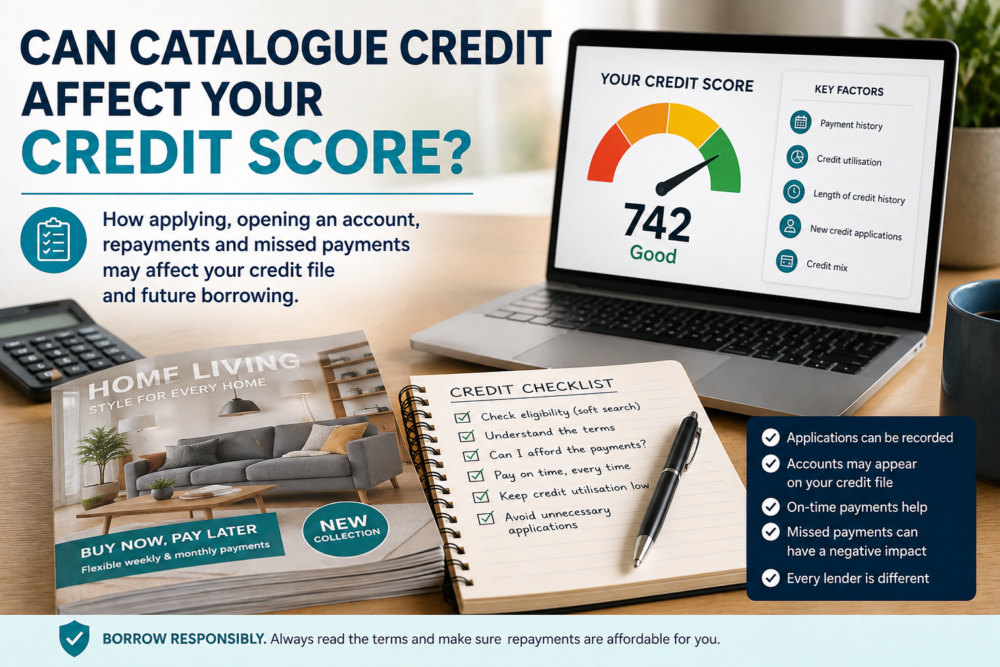
Can catalogue credit affect your credit score? It may do, depending on how the account is reported and managed. Applying for credit, opening an account and missing payments can all be relevant. However, the exact effect can vary.
Catalogue providers do not all report information in the same way. Credit reference agencies may also hold different information about you.
So, it is important to understand both your credit score and your credit file.
This guide explains when catalogue credit can affect your credit score. It also covers soft searches, hard searches, repayments, missed payments and affordability.
Important: BuyNowPayLaterCatalogue.co.uk is an independent information and referral website. We are not a lender and do not provide credit. Credit products, eligibility rules, costs and terms vary between providers. Always check the provider’s current terms before entering into a credit agreement.
How Can Catalogue Credit Affect Your Credit Score?
Several parts of using catalogue credit may be relevant to your credit history.
First, a provider may search your credit file.
Next, an account may be opened and reported to one or more credit reference agencies.
Your payment history may then be reported.
For example, payments made on time may appear on your credit file if the provider reports them.
Missed or late payments may also be reported.
Therefore, whether catalogue credit can affect your credit score depends partly on how the provider reports the account.
It also depends on the information already held on your credit file.
Can Applying for Catalogue Credit Affect Your Credit Score?
Applying for catalogue credit may involve a credit search.
However, not all searches work in the same way.
A provider may carry out a soft search.
Alternatively, a full application may involve a hard credit search.
A hard application search can be visible to other lenders.
Therefore, several applications within a short period may be relevant when another lender assesses you.
This does not mean one application will automatically cause a major change to your credit score.
The effect depends on the circumstances and the scoring system being used.
Can a Soft Search Make Catalogue Credit Affect Your Credit Score?
A soft search does not affect your credit score in the same way as a hard application search.
You may be able to see a soft search on your own credit report.
However, other lenders do not see it in the same way as a hard search.
For example, some eligibility tools use soft searches.
This can help you explore whether you may meet initial lending criteria.
However, a positive eligibility result does not guarantee acceptance.
A provider may carry out further checks later.
Our guide to what a soft credit check is explains this process in more detail.
Can a Hard Search Make Catalogue Credit Affect Your Credit Score?
A hard search is different from a soft search.
Hard searches are often linked to formal credit applications.
They can normally be seen by other lenders when they review your credit file.
Therefore, making several applications in a short period may matter.
For example, a lender may consider recent applications when assessing your creditworthiness.
However, there is no universal number of applications that automatically causes a refusal.
Likewise, there is no fixed number of credit-score points that every hard search will remove.
Different credit reference agencies and lenders use different scoring methods.
Can Opening Catalogue Credit Affect Your Credit Score?
Opening a new credit account may change information on your credit file.
This can happen if the provider reports the account to a credit reference agency.
For example, your report may show that a new account has been opened.
It may also show the balance and payment history.
Therefore, a new catalogue account can become part of your wider credit history.
However, the effect on a credit score can vary.
Your existing accounts, balances and payment history may all be relevant.
So, avoid assuming that simply opening catalogue credit will either improve or damage your score.
Can Repaying Catalogue Credit Affect Your Credit Score?
Repayment history can be important when information is reported to credit reference agencies.
If a provider reports your account, payments may form part of your credit history.
Paying as agreed may show that the account is being maintained under its terms.
However, this does not mean that each payment will increase your score.
Credit scores do not work like a simple points reward system.
Several factors may be considered at the same time.
Therefore, do not take out catalogue credit only because you hope it will increase your credit score.
Borrow because the purchase is needed and the payments are affordable.
Can Missed Catalogue Payments Affect Your Credit Score?
Missed payments may be reported to credit reference agencies.
If that happens, they may become part of your credit history.
This can make it harder to obtain some forms of credit in the future.
However, reporting practices can vary.
So, check the provider’s terms to understand how payment information may be handled.
If you know you will struggle to make a payment, contact the provider early.
Do not simply ignore the problem.
Our guide on what happens if you miss catalogue payments covers this subject in more detail.
Can Late Catalogue Payments Affect Your Credit Score?
A late payment and a missed payment are closely linked, but the exact reporting can vary.
A provider may report payment information to one or more credit reference agencies.
Therefore, paying later than agreed could affect the information held on your credit file.
It may also lead to other consequences under your agreement.
For example, the provider may contact you about the overdue amount.
So, check your payment dates carefully.
If possible, use reminders or another system to keep track of due dates.
Most importantly, contact the provider if you cannot pay on time.
How Long Can Catalogue Credit Affect Your Credit Score?
There is no single answer to how long catalogue credit can affect your credit score.
This is because your credit score can change over time.
Your credit file also contains different types of information.
Some information can remain on a credit report for several years.
For example, missed payments and defaults may remain visible for a set period under credit reporting practices.
However, the impact of information on a lending decision can vary.
Lenders use their own criteria.
They may also place different weight on older and newer information.
Therefore, avoid thinking of a credit score as a permanent mark.
Does Every Catalogue Report to Credit Reference Agencies?
You should not assume that every catalogue provider reports accounts in the same way.
A provider may share information with one or more credit reference agencies.
Another provider may have different reporting arrangements.
In addition, the information reported may depend on the product.
Therefore, check the provider’s privacy notice and credit information.
This can help you understand how your account data may be used.
If you are unsure, ask the provider directly.
Which Credit Reference Agencies May Hold Catalogue Information?
The UK’s main consumer credit reference agencies include Experian, Equifax and TransUnion.
However, they do not always hold identical information.
A lender may report to one agency, several agencies or use different arrangements.
As a result, one credit report may look different from another.
This is another reason why the question “Can catalogue credit affect your credit score?” does not have one universal answer.
The score you see can depend on the agency and service you use.
Why Can Credit Scores Be Different?
You do not have one universal UK credit score.
Different credit reference agencies can calculate scores in different ways.
The scale can also vary.
For example, a score described as “good” by one service cannot always be compared directly with a score from another.
Lenders may also use their own scoring systems.
They can combine credit-file data with information from your application.
Therefore, the score you see is useful, but it does not guarantee a lending decision.
Can Catalogue Credit Improve Your Credit Score?
It is possible for well-managed credit to form part of a positive credit history.
However, you should be careful with claims that catalogue credit will “build” or “repair” your score.
There is no guaranteed result.
If account information is reported, paying as agreed may form part of your payment history.
Yet many other factors can also affect your credit profile.
Therefore, you should not borrow simply to try to increase a score.
Taking on unnecessary credit creates a real payment commitment.
Instead, focus on managing the credit you already have responsibly.
Can Catalogue Credit Lower Your Credit Score?
In some circumstances, catalogue credit can affect your credit score in a negative way.
For example, a hard application search may be recorded.
A new account may also change your overall credit profile.
In addition, missed payments may be reported.
High levels of existing borrowing may also be relevant to lenders.
However, the exact score impact cannot be predicted.
Different scoring systems use information differently.
Therefore, avoid claims that a certain action will reduce your score by a fixed number of points.
Can Several Catalogue Accounts Affect Your Credit Score?
Having several catalogue accounts may affect your wider credit profile.
For example, each application could involve a credit search.
New accounts may also appear on your credit file.
In addition, several accounts can mean several payment commitments.
This may be relevant when a lender considers affordability and creditworthiness.
Therefore, think carefully before opening several accounts at once.
Ask whether you actually need the extra credit.
Also consider whether you could still afford all payments if your circumstances changed.
Can Your Catalogue Credit Limit Affect Your Credit Score?
A credit limit is the maximum amount of credit available on an account.
If an account and its limit are reported, this information may form part of your credit file.
How much of your available credit you use can also be relevant to some scoring systems.
However, there is no single percentage that guarantees a particular score.
Therefore, be careful with rules that claim everyone must stay below one exact level.
More importantly, do not treat an available credit limit as money that should be spent.
A lender’s limit is not the same as your personal budget.
Catalogue Credit, Credit Scores and Affordability
Your credit score and affordability are not the same thing.
This distinction matters.
A credit score is linked to credit risk.
Affordability looks at whether repayments may place too much pressure on your finances.
For regulated consumer credit, affordability risk forms part of the lender’s wider creditworthiness assessment.
Therefore, having a strong-looking credit score does not automatically mean new borrowing is affordable.
Likewise, affordability cannot be judged from a score alone.
Our guide to what an affordability assessment is explains this in plain English.
Catalogue Credit, Credit Scores and Income
Your income does not usually form part of a standard credit score in the same way as your reported credit history.
However, income can still matter when you apply for credit.
A lender may ask about your income and other financial circumstances.
This can help it assess affordability.
Therefore, a high credit score should not be treated as proof that you can afford a new payment.
Your real household budget matters too.
Always compare the proposed payment with the money you have left after essential costs.
Catalogue Credit, Credit Scores and Pre-Payments
Some catalogue arrangements may require payments before goods are dispatched.
However, pre-payments should not be viewed as a guaranteed way to improve your credit score.
A number of pre-payments may be required in some cases.
The exact requirement can vary by provider, product and customer.
Also, reporting practices can differ.
Therefore, check how the provider handles your account information.
Our catalogue pre-payments guide explains how these payments may work.
Catalogue Credit, Credit Scores and Weekly Payments
Paying weekly rather than monthly does not automatically improve your credit score.
The payment frequency is only one feature of the agreement.
What matters is whether you understand and can manage the commitment.
For example, weekly payments may suit someone who is paid weekly.
Monthly payments may suit another person’s budget better.
Neither option is automatically better.
Our pay weekly vs pay monthly guide explains the differences.
Can 0% Catalogue Credit Affect Your Credit Score?
Yes. Interest and credit reporting are separate issues.
A 0% interest rate does not mean an account cannot appear on your credit file.
Likewise, an interest-free credit application may still involve a credit check.
Payment information may also be reported, depending on the provider and product.
Therefore, 0% APR should not be confused with “no effect on your credit file”.
It also does not mean the borrowing is automatically affordable.
You still need to make the required payments.
Can Regulated Catalogue Credit Affect Your Credit Score?
Regulatory status and credit reporting are separate issues.
A regulated credit agreement may involve credit-file checks and reporting.
However, you should not assume every regulated product is reported in exactly the same way.
Likewise, you cannot decide whether an agreement is regulated simply by checking whether it appears on a credit report.
Since 15 July 2026, certain Deferred Payment Credit agreements have also come under FCA regulation.
However, some merchant-provided arrangements can remain outside that new regime.
Our regulated vs unregulated credit guide explains the distinction in more detail.
Can Unregulated Catalogue Credit Affect Your Credit Score?
Do not assume that unregulated credit can never affect your credit file.
Regulatory status and credit reporting are not the same thing.
The key question is whether information about the account is shared with a credit reference agency.
Therefore, check the provider’s terms and privacy information.
Also remember that regulation is a legal question.
You should not decide an agreement’s status based only on its length, payment frequency or credit reporting.
Can Closing Catalogue Credit Affect Your Credit Score?
Closing an account can change your overall credit profile.
For example, it may alter the amount of credit available to you.
It can also change the mix of open accounts shown on your file.
However, the exact effect on a score can vary.
Therefore, do not keep an account open solely because you believe closing it will always damage your score.
Instead, consider whether you still need the account.
Also check whether there is any balance left to pay.
How to Check Whether Catalogue Credit Has Affected Your Credit File
You can check your credit reports to see what information is recorded.
First, check your personal details.
Next, look at your open and closed credit accounts.
Then review the payment history.
Also look at searches recorded on the file.
If you see catalogue credit, check whether the details appear correct.
If something looks wrong, contact the organisation that supplied the information.
You can also contact the credit reference agency if needed.
What if Your Catalogue Credit Information Is Wrong?
Credit-file information should be accurate.
If you find information you believe is wrong, do not ignore it.
First, check the account details carefully.
Then contact the provider that supplied the information.
Explain what you believe is incorrect.
Provide supporting information where you can.
You may also be able to raise a dispute with the credit reference agency.
Keep copies of your messages and any evidence you send.
How to Reduce the Risk of Catalogue Credit Affecting Your Credit Score
You cannot control every factor used in credit scoring.
However, you can take sensible steps when using catalogue credit.
- Check whether the application uses a soft or hard search.
- Avoid making unnecessary credit applications.
- Read the payment schedule before agreeing.
- Make payments by the agreed due dates.
- Keep track of several credit accounts in one budget.
- Do not use a credit limit simply because it is available.
- Contact the provider early if you may miss a payment.
- Check your credit reports for errors.
Above all, borrow only when the repayments fit your budget.
A credit score should not be the main reason for taking on new debt.
Should You Use Catalogue Credit to Build Your Credit Score?
Taking out catalogue credit only to build a credit score can create unnecessary debt.
There is also no guaranteed improvement.
Therefore, think about the reason for borrowing first.
If you need an item, compare the cash price with the total credit cost.
Then check the payments.
Also consider alternatives.
For example, you may be able to save first or buy the item for less elsewhere.
The aim should be a manageable financial decision, not chasing a particular credit score.
Catalogue Credit and Credit Score Questions to Ask
Before opening an account, ask:
- Will an eligibility check use a soft search?
- Will a full application use a hard search?
- Will the account be reported to a credit reference agency?
- Which credit reference agencies may receive information?
- Could missed payments be reported?
- How much will I need to repay?
- How often are payments due?
- Can I afford the payments after essential bills?
- Do I need the item now?
- Could I save and buy it later instead?
These questions help you look beyond the credit score itself.
They also help you consider the real cost and commitment.
Catalogue Credit and Credit Score FAQs
Can Catalogue Credit Affect Your Credit Score?
Yes. Catalogue credit can affect your credit score in some circumstances. Applications, new accounts and payment history may all be relevant. However, the exact effect varies.
Does Applying for Catalogue Credit Affect Your Credit Score?
It depends on the search used. A soft search does not affect your score in the same way as a hard application search. A formal application may involve a hard search.
Can Paying Catalogue Credit Improve Your Credit Score?
Paying an account as agreed may form part of your credit history if the provider reports it. However, there is no guaranteed score increase. Do not borrow solely to try to improve your score.
Can Missing Catalogue Payments Affect Your Credit Score?
Yes, missed payments may affect your credit history if they are reported. This may make some future borrowing harder to obtain.
Does 0% Catalogue Credit Affect Your Credit Score?
It can. A 0% interest rate does not prevent credit checks or credit reporting. Interest and credit reporting are separate issues.
Do Catalogue Pre-Payments Improve Your Credit Score?
There is no guaranteed improvement. Whether payments are reported depends on the arrangement and provider. Therefore, do not make catalogue pre-payments simply to try to increase a score.
Can Several Catalogue Accounts Affect Your Credit Score?
Several accounts can change your overall credit profile. Multiple applications may also result in several searches. In addition, each account can create another payment commitment.
Will Closing a Catalogue Account Hurt My Credit Score?
The effect can vary. Closing an account may change your wider credit profile, but there is no universal result. Consider whether you need the account rather than keeping it open only for a score.
Can Catalogue Credit Affect Your Credit Score? Key Points
Yes, catalogue credit can affect your credit score and wider credit history in some circumstances.
However, there is no single effect that applies to everyone.
A soft search is different from a hard application search.
A new account may appear on your credit file if it is reported.
Payment history may also be recorded.
Therefore, late or missed payments can matter.
However, paying on time does not guarantee that your score will rise.
Likewise, there is no fixed number of points that catalogue credit will add or remove.
Credit reference agencies use different scoring systems.
Lenders can use their own criteria too.
So, focus on the wider picture.
Check the cost of the credit.
Check whether the application involves a hard search.
Then make sure the repayments are affordable.
Most importantly, do not borrow simply to try to improve a credit score.
If you are struggling with debt or household bills, free support is available. MoneyHelper, Citizens Advice and StepChange provide independent information and support.
For more general information, visit our Buy Now Pay Later Catalogue information hub.
Editorial information: This guide provides general information about catalogue credit, credit files and credit scores in the UK. BuyNowPayLaterCatalogue.co.uk is not a lender. It is not personal financial advice. Credit checks, credit reporting and lending criteria can vary between providers. Credit products and provider terms can also change. Check the current terms of any agreement before applying.
Last reviewed: August 2026.