Alternatives to Catalogue Credit: UK Guide
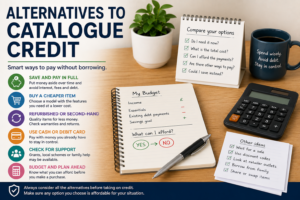
Alternatives to catalogue credit can help you compare other ways to pay before taking on a new credit agreement. These options may include saving, buying a cheaper item or choosing a refurbished product.
Catalogue credit can be useful in some cases. However, it also creates a payment commitment.
Therefore, it is sensible to compare your options before you borrow.
This guide explains common alternatives to catalogue credit. It also looks at costs, budgeting, risks and when free financial support may be useful.
Important: BuyNowPayLaterCatalogue.co.uk is an independent information and referral website. We are not a lender and do not provide credit. Credit products, eligibility rules, costs and terms vary between providers. Always check the provider’s current terms before entering into a credit agreement.
What Are Alternatives to Catalogue Credit?
Alternatives to catalogue credit are other ways to buy goods without using a catalogue account.
For example, you could save and pay in full.
You could also choose a cheaper item.
In some cases, a refurbished or second-hand product may meet your needs.
Other forms of credit may also exist.
However, switching from catalogue credit to another loan or payment plan does not remove the risks of borrowing.
Therefore, compare the full cost before deciding.
Why Consider Alternatives to Catalogue Credit?
Credit creates an ongoing payment commitment.
That commitment can affect your future budget.
For example, your income may fall.
Your household costs may also rise.
Therefore, a payment that looks affordable today could become harder later.
Looking at alternatives to catalogue credit gives you more choice.
It can also help you avoid borrowing when another option may suit you better.
Saving as an Alternative to Catalogue Credit
Saving is one of the simplest alternatives to catalogue credit.
Instead of borrowing, you put money aside until you can afford the item.
This can take longer.
However, you avoid taking on a new credit agreement.
You may also have more freedom to shop around.
For example, you can compare several retailers before paying.
In addition, there is no repayment schedule to manage after the purchase.
When Saving May Work Well
Saving may work well when the purchase is not urgent.
For example, you may want a new TV but your current one still works.
You could set aside a small amount each week or month.
Over time, this can build towards the full price.
Therefore, saving can reduce the need for credit.
When Saving May Be Harder
Saving may not always be practical.
For example, an essential appliance may break without warning.
You may need a replacement sooner than expected.
In that case, waiting may not be possible.
However, you can still compare lower-cost products and other payment options.
Buying a Cheaper Item as an Alternative to Catalogue Credit
Choosing a lower-cost product can be another useful option.
You may not need the most expensive model.
For example, a smaller TV may meet your needs.
A simpler washing machine may also do the job.
Therefore, compare features before focusing on price alone.
Ask which features you actually need.
This can help reduce the amount you need to spend.
Refurbished Goods as an Alternative to Catalogue Credit
Refurbished goods can be one of the more affordable alternatives to catalogue credit.
A refurbished product has usually been checked, repaired or restored before resale.
It may cost less than a brand-new item.
However, quality can vary.
Therefore, check the seller carefully.
Also check the warranty and returns policy.
For electrical items, make sure the product comes from a trusted source.
Second-Hand Goods as an Alternative to Catalogue Credit
Second-hand items may also reduce the cost of a purchase.
For example, furniture can often be bought used.
Some technology products may also be available second-hand.
However, there can be more risk.
A private seller may offer fewer protections than a retailer.
Therefore, inspect the item where possible.
Also check whether it works as expected.
For large purchases, ask about delivery costs too.
Interest-Free Savings Plans as Alternatives to Catalogue Credit
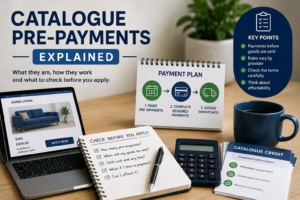
Some retailers may let you pay towards an item before you receive it.
This can work more like saving than borrowing.
However, the exact setup can vary.
Therefore, check whether a credit agreement is involved.
Also check what happens if you cancel.
Ask whether your money is protected.
Finally, check when the goods will be supplied.
Do not assume every pre-payment plan works in the same way.
Cash Purchases as Alternatives to Catalogue Credit
Paying in full can be one of the clearest alternatives to catalogue credit.
You pay once and do not have future repayments.
This can make budgeting simpler.
However, paying in full can reduce your savings.
Therefore, think about emergency funds too.
Do not use all your available money if that would leave you unable to handle an urgent bill.
Debit Cards as Alternatives to Catalogue Credit
A debit card uses money already in your bank account.
So, it does not create the same type of borrowing as catalogue credit.
This can help you avoid future repayments.
However, you still need enough money available.
Therefore, check your balance before buying.
Also think about upcoming bills.
Do not spend money that is already needed for rent, food or other essentials.
Credit Cards as Alternatives to Catalogue Credit
A credit card is another form of borrowing.
Therefore, it is not a debt-free alternative.
However, some people may compare it with catalogue credit.
For example, a card may offer an interest-free purchase period.
However, interest may apply if the balance is not cleared under the offer terms.
You should also check any fees.
Therefore, compare the total cost and repayment rules carefully.
A low minimum payment does not mean the debt will be cleared quickly.
Personal Loans as Alternatives to Catalogue Credit
A personal loan may be used for a larger purchase.
However, it is still credit.
You borrow a fixed amount and repay it over time.
Interest may apply.
Therefore, compare the APR and total amount payable.
Also check the repayment term.
A longer term may reduce the monthly payment.
However, it can increase the total interest paid.
So, do not compare loans using the monthly payment alone.
Credit Union Loans as Alternatives to Catalogue Credit
A credit union may offer loans to its members.
These can be worth comparing with other forms of credit.
However, you may need to meet membership rules.
Interest can also apply.
Therefore, check the total cost.
Also check the repayment period and eligibility rules.
Do not assume a credit union loan is automatically suitable because it comes from a community-based provider.
Employer Schemes as Alternatives to Catalogue Credit
Some employers offer salary-linked purchase or savings schemes.
These may cover certain goods or services.
However, the terms can vary a lot.
Therefore, check how payments are taken.
Also check what happens if you leave your job.
Ask whether any credit agreement is involved.
Finally, compare the total cost with buying elsewhere.
Family Help as an Alternative to Catalogue Credit
Some people may be able to borrow from family or friends.
This may avoid commercial interest or charges.
However, informal borrowing can still create problems.
For example, it can put pressure on relationships.
Therefore, agree clear terms.
Write down how much is being borrowed.
Also agree when it will be repaid.
Do not borrow informally if repayment is likely to cause conflict or hardship.
Community Support as an Alternative to Catalogue Credit
In some cases, local support may be available.
For example, charities or councils may offer help with essential items.
This can depend on where you live and your circumstances.
Therefore, check local support before borrowing for an urgent need.
Citizens Advice may also help you find local schemes.
This can be useful when the purchase is essential rather than optional.
Grants as Alternatives to Catalogue Credit
Some people may qualify for grants.
A grant does not usually need to be repaid.
However, eligibility rules apply.
For example, some grants may help with essential household items.
Others may be linked to work, health, family status or location.
Therefore, check whether support is available before borrowing.
Do not pay a fee to a company that promises a grant without checking it carefully.
Budgeting as an Alternative to Catalogue Credit
A simple budget can help you see whether you need credit at all.
First, list your income.
Next, write down your essential costs.
Then include existing debt payments.
After that, look at what remains.
You may find that saving for the item is possible.
Alternatively, the budget may show that a new payment would be too tight.
Therefore, budgeting can help you compare alternatives to catalogue credit.
Alternatives to Catalogue Credit for Essential Items
An essential purchase can feel more urgent.
For example, you may need a bed, fridge or washing machine.
In that case, compare several options quickly.
First, look for lower-cost models.
Next, check refurbished goods.
Then look for local support or grants.
Finally, compare any credit options that remain.
Do not let urgency stop you from checking the terms.
Alternatives to Catalogue Credit for Non-Essential Items
For non-essential purchases, waiting can be a strong option.
For example, a new TV or gaming device may be something you want rather than need.
In that case, saving may be more suitable.
You can also watch for normal retail price reductions.
Therefore, consider delaying the purchase.
This can help you avoid taking on a new payment commitment.
Alternatives to Catalogue Credit and 0% Offers
A 0% offer can look attractive.
However, 0% interest does not mean the purchase is automatically affordable.
You still need to repay the amount borrowed.
Therefore, compare the regular payment with your budget.
Also check the total price.
In some cases, paying cash elsewhere may still be cheaper.
So, do not focus only on the interest rate.
Alternatives to Catalogue Credit and Your Credit Score
Using less credit may reduce the need for new applications.
This can matter because some applications involve hard credit searches.
However, avoiding catalogue credit does not guarantee a higher credit score.
Credit scoring is more complex.
Therefore, do not choose an option only because you think it will improve your score.
Instead, focus on cost and affordability.
Our guide to how catalogue credit can affect your credit score explains this in more detail.
Alternatives to Catalogue Credit and Affordability
Affordability should guide your decision.
For example, a cheaper product may be easier to manage without credit.
Saving may also avoid future repayments.
However, another form of credit can still create pressure.
Therefore, check your budget first.
Our guide to what an affordability assessment is explains how affordability can be considered.
Alternatives to Catalogue Credit and Weekly Payments
A weekly payment can look small.
However, it is due more often.
Therefore, do not compare weekly credit with cash using one payment alone.
Look at the full cost.
Then compare it with saving the same weekly amount.
For example, you may be able to save towards the item instead.
Our pay weekly vs pay monthly guide explains how payment frequency can affect budgeting.
Alternatives to Catalogue Credit and Pre-Payments
Some catalogue plans require pre-payments before dispatch.
In that case, compare the plan with saving directly.
If you are already making payments before receiving the item, saving may be worth considering.
However, the two options are not the same.
A catalogue arrangement may involve credit and contract terms.
Therefore, check the agreement carefully.
Our catalogue pre-payments guide explains how these arrangements can work.
Alternatives to Catalogue Credit When You Already Have Debt
If you already have several debts, more credit may make budgeting harder.
Therefore, look at the full picture first.
Write down every debt payment.
Then add essential household costs.
If very little money remains, another agreement may not be suitable.
In that case, consider lower-cost options or delay the purchase.
If the debt is already difficult to manage, free advice may help.
Alternatives to Catalogue Credit If You Have Poor Credit
Poor credit can limit some borrowing options.
However, this does not mean you should accept expensive credit.
First, consider whether you can wait and save.
Next, check cheaper goods.
You could also look at refurbished items.
For essential items, check local help.
Therefore, avoid assuming that another high-cost loan is your only choice.
Alternatives to Catalogue Credit if You Are Declined
If a catalogue application is declined, avoid making many new applications straight away.
Several applications may involve several hard searches.
Instead, review your budget.
Check whether the purchase can wait.
You may also want to check your credit reports for errors.
However, a decline does not always mean there is an error.
Lenders can use their own criteria.
Therefore, consider non-credit options before applying again.
Alternatives to Catalogue Credit if You Miss Payments
If you already miss catalogue payments, taking more credit may add pressure.
Therefore, deal with the existing problem first.
Contact the provider.
Check what you can afford.
Then seek free advice if needed.
Our guide to what happens if you miss catalogue payments explains the next steps.
How to Compare Alternatives to Catalogue Credit
Use the same questions for every option.
First, ask what the item costs in cash.
Then ask what the total credit cost would be.
Next, check how long you will be paying.
Also check interest and fees.
Then consider delivery times.
Finally, look at your budget.
This makes it easier to compare alternatives to catalogue credit fairly.
Questions to Ask About Alternatives to Catalogue Credit
Before choosing a payment option, ask:
- Do I need the item now?
- Could I save for it?
- Is there a cheaper model?
- Could I buy refurbished?
- Could I buy second-hand?
- Is local support available?
- Could I qualify for a grant?
- What is the cash price?
- What is the total credit cost?
- Will interest apply?
- Are there any fees?
- Can I afford the repayments?
- What happens if my income falls?
- What happens if I miss a payment?
These questions can help you make a more informed choice.
Alternatives to Catalogue Credit FAQs
What Are the Main Alternatives to Catalogue Credit?
Main alternatives to catalogue credit include saving, buying a cheaper item, choosing refurbished goods and paying in full. Other forms of credit may also be available, but they still involve borrowing.
Is Saving Better Than Catalogue Credit?
Saving avoids a new credit agreement. However, it may take longer. Whether it suits you depends on how urgent the purchase is.
Are Refurbished Goods a Good Alternative?
They can be. Refurbished items may cost less than new products. However, check the seller, warranty and returns policy.
Should I Use a Credit Card Instead of Catalogue Credit?
A credit card is still borrowing. Therefore, compare interest, fees and the total repayment cost before deciding.
Are Personal Loans Better Than Catalogue Credit?
Not automatically. A personal loan may have different costs and terms. Compare the APR, total amount payable and repayment period.
Can I Get Help With Essential Items Without Borrowing?
Possibly. Some councils, charities and support schemes may help with essential household items. Eligibility rules vary.
Should I Borrow if I Already Have Debt?
Think carefully. Another credit agreement adds another repayment. If your current debts are hard to manage, free debt advice may be more useful.
What Should I Do if I Am Declined for Catalogue Credit?
Avoid making many new applications straight away. Review your budget, check your credit reports and consider non-credit options first.
Alternatives to Catalogue Credit: Key Points
Alternatives to catalogue credit can help you avoid taking on a new payment commitment.
Saving is one option.
Buying a cheaper item may also help.
Refurbished or second-hand goods can reduce the price too.
For essential purchases, local support or grants may be worth checking.
Other forms of credit may also be available.
However, they still involve borrowing.
Therefore, compare the full cost.
Do not look only at the weekly or monthly payment.
Also check interest and fees.
Most importantly, compare the payment with your budget.
If you already have debt problems, another credit agreement may make them harder to manage.
In that case, seek free help before borrowing more.
MoneyHelper, Citizens Advice and StepChange provide free information and support.
For more general information, visit our Buy Now Pay Later Catalogue information hub.
Editorial information: This guide provides general information about alternatives to catalogue credit in the UK. BuyNowPayLaterCatalogue.co.uk is not a lender. It is not personal financial advice. Costs, eligibility rules and product terms can vary. Check current information before entering into any credit agreement.
Last reviewed: August 2026.